Find a Range Getting StartedFirearms, Safety & Information HubShooting Organisations and AssociationsEventsClub & Organisation ResourcesOur Purpose
FIREARMS & SAFETY HUB

Firearms Safety & Information Hub

The Firearms Safety & Information Hub is designed to provide clear, accessible and reliable information about firearms, safe handling practices and licensing requirements across Australia. Whether you're new to shooting sports or an experienced shooter, the Hub helps you understand your responsibilities, navigate state and territory regulations, and access essential resources to support safe, responsible and lawful participation in shooting sports.

Firearms information and safety resources

01

Firearm & Pistol Acquisition

Acquisition, licensing, authorisations and waiting periods by state and territory.
02

Firearm Storage Requirements

Storage requirements, official authority guidance and legislation by jurisdiction.
03

Travelling with firearms

Moving firearms to and from the range, interstate and overseas.

Safety

01

Personal Protective Equipment (PPE)

Eye and hearing protection for shooters and range users.
02

Range Commands

Common Australian range commands, safety briefings and discipline-specific examples.

RANGE FINDER AUSTRALIA | FIREARMS & SAFETY HUB

Australian Shooting Range Commands & Safety Procedures

Educational reference • Australian pistol, rifle, shotgun and clay-target disciplines

Important safety information

Australia does not have one identical set of range commands used word-for-word by every shooting organisation. The commands below are common examples or discipline-specific terminology, not a substitute for current rules. Range Standing Orders, the current competition rulebook and directions from the Range Officer always take precedence.

Common range commands and terminology

Command / variationGeneral meaning
Command / variationShooters / Competitors to the lineGeneral meaningProceed to the designated firing position when instructed.
Command / variationPreparation timeGeneral meaningA designated preparation period; firearm handling rules vary by discipline.
Command / variationLoad / Load and make readyGeneral meaningPrepare or load only when authorised and in accordance with the applicable rules.
Command / variationAre you ready? / Is the line ready?General meaningA readiness check before the start.
Command / variationStandby / AttentionGeneral meaningA warning that the start signal or timed sequence is approaching.
Command / variationCommence Fire / Fire / Start / UpGeneral meaningBegin firing only under the applicable range or match procedure.
Command / variationCease fire / StopGeneral meaningStop firing immediately and follow the Range Officer’s instructions.
Command / variationUnload / Unload and show clearGeneral meaningUnload and present the firearm for inspection as instructed.
Command / variationRange clear / Range is clearGeneral meaningA declaration by an authorised official after prescribed safety checks.
Command / variationNo handling of firearmsGeneral meaningDo not touch or handle firearms until specifically authorised.
Command / variationGo forward / Score and patchGeneral meaningProceed towards targets only after explicit permission and the required safety checks.

Note: Similar-sounding commands may have different formal meanings in different disciplines. “Range clear” is not independent permission for a visitor to handle firearms or go forward.

Discipline-specific examples

Supplied educational examples — original document wording

Supplied educational draft — not authoritative commands or a universal operating sequence

Source-verified educational context and corrections

IPSC Australia — Practical shooting

Supplied draft wording

Load and Make Ready / Make Ready • Are You Ready? • Standby • Start Signal • Stop • If You Are Finished, Unload and Show Clear • If Clear, Hammer Down, Holster (handgun-specific) • Range Is Clear

Exact wording and sequence vary by handgun, rifle and shotgun rulebook.

Verified rulebook context

Selected terminology from section 8.3, not a compulsory sequence for every Australian range or an operating guide. Start Signal identifies a signal, not necessarily spoken words; Stop may interrupt a course of fire and is not a routine required step. The handgun closing wording does not apply to rifle or shotgun, whose closing commands differ. Follow the applicable current discipline rules, stage briefing, Range Standing Orders and Range Officer directions.

  • Load And Make Ready
  • Make Ready — only for starts with an unloaded firearm
  • Are You Ready?
  • Standby
  • Start Signal
  • Stop
  • If You Are Finished, Unload And Show Clear
  • If Clear, Hammer Down, Holster — handgun-specific
  • Range Is Clear
Rulebook references
  • IPSC Handgun Competition RulesJanuary 2026 edition · 8.3.1–8.3.8
  • Official IPSC rulebooks and current interpretationsHandgun, Rifle and Shotgun January 2026 editions; current interpretations · 8.3

Last verified 13 November 2026

Pistol Australia / ISSF-style target pistol

Supplied draft wording

Preparation Time • Load • Start • Attention (certain timed events) • Stop • Unload

Timing systems, signals and event-specific procedures may supplement spoken commands.

Verified rulebook context

Examples vary by event, target system and qualification/finals format; this is not one six-step national script. Timing systems and visual signals can replace spoken START/STOP in specified events. ATTENTION is not itself permission to commence firing. The Australian TPA addendum applies to TPA-supervised competitions; state and territory adoption can vary, and later international changes are not automatically adopted. Follow the current applicable event rules and Range Officer directions.

  • PREPARATION AND SIGHTING TIME…START — 10m air-pistol qualification
  • END OF PREPARATION AND SIGHTING…STOP — 10m air-pistol qualification
  • MATCH FIRING…START — 10m air-pistol qualification
  • STOP
  • PREPARATION TIME BEGINS NOW — 25m events
  • LOAD
  • ATTENTION — specified 25m events
  • UNLOAD
Rulebook references
  • ISSF Rule Book 2026Edition 2025, Third Print October 2026; effective 19 October 2026 · 6.2.3; 6.11.1; 8.7.6
  • Australian TPA addendum and reproduced ISSF sectionsApril 2026, TPA variations v1.1; reproduced ISSF First Print effective January 2026 · Introductory pages 1–2; Sections 6 and 8

Last verified 13 November 2026

SSAA — Rifle, pistol and combined services

Supplied draft wording

Ready • Load • Commence Fire / Fire • Cease Fire • Unload and Show Clear • Clear the Firing Line • No Handling of Firearms • Score and Patch

SSAA disciplines have distinct procedures; do not assume one uniform SSAA sequence.

Verified rulebook context

SSAA — Combined Services rifle and pistol

These selected Combined Services examples are not a complete procedure or a single SSAA-wide sequence. Ready is a pistol position in these rules, not the standalone command assumed by the draft. Rifle and pistol command lists differ; Commence Fire appears in particular supplementary events and is not freely interchangeable with Fire. Follow the current applicable Standard Rules, discipline rules, Range Standing Orders and Range Officer directions.

  • Load
  • Fire
  • Cease Fire
  • Clear the Firing Line
  • Unload; Show Clear — separate rifle commands
  • Unload & Show Clear — main pistol list
  • Is any shooter not ready — specified Option 2 courses
  • The firing line is closed, no handling of firearms on the firing line
  • You may move forward, collect brass, score and patch
Rulebook references
  • SSAA Combined Services Official National Rules No. 5Revised November 2022; currently linked official edition · 4.5.1; 7.5.1 and Option 2; Annexes 5A and 8A
  • SSAA Standard Rules No. 9.3Revised November 2025; takes precedence over relevant discipline rules · Introductory precedence statement; 2.4.4

Last verified 13 November 2026

NRAA — Fullbore and long-range rifle

Supplied draft wording

Commence Fire • One Minute Remaining • Cease Fire / Cease Firing • Remove Bolts and Have Rifle Cleared

Sighting, record-fire, timing and target operations are governed by the relevant current rules.

Not verified — source-integrity caution

Not verified — source-integrity caution: The original NRAA word list above has not been verified as a universal fullbore, Target Rifle (TR) or F-Class procedure. The earlier source audit associated this wording with Benchrest rather than universal fullbore rules. Current NRAA pages contain unrelated adult/spam material, and no safe independent current rulebook mirror has been verified. No source-verified NRAA group is available here; its website address is retained only as non-clickable original source text. Do not use this draft word list as operating instructions. Follow the applicable current rules, local Range Standing Orders and Range Officer directions.

ACTA — Trap, skeet and sporting clays

Supplied draft wording

Start • Pull (or equivalent shooter target call) • Stop • No Target • Lost Target • One / Two (event-specific scoring calls)

“Pull” requests a target; “No Target” is a referee’s ruling. These are not general firing-line commands.

Verified rulebook context

ACTA — Trap and skeet terminology

These shooter calls and referee rulings are not general firing-line commands or a nationally universal sequence. They are narrowed to ACTA trap and skeet, not every sporting-clays format; one/two calls depend on the event and are not a universal scoring scale. START/STOP are separately recognised range commands in the ACTA ISSF section. ACTA rules apply to ACTA or authorised events; follow the applicable discipline rules and Range Officer directions.

  • Pull, or a similar shooter call — requests a target
  • No target — a referee ruling that the target does not count
  • Lost target — a referee scoring call
  • One / Two — event-specific result calls
Rulebook references
  • Australian Clay Target Association Shooting RulesEffective July 2026; current official latest download · 1.21.6–1.21.8; 4.1(c), 4.5 and 4.7; 6.1(c), 6.7 and 6.9; ISSF 5.2.3–5.2.4

Last verified 13 November 2026

Official organisations and reference starting points

Source-document reference starting points, not rulebook verification or an endorsement of current website content. Use the qualified rulebook references beside the matching examples. The NRAA address is plain source text only while its integrity hold remains unresolved.

  • IPSC Australia — https://ipsc.org.au/
  • Pistol Australia — https://pistol.org.au/
  • Sporting Shooters’ Association of Australia (SSAA) — https://www.ssaa.org.au/
  • National Rifle Association of Australia (NRAA) — https://nraa.com.au/
  • Australian Clay Target Association (ACTA) — https://www.claytarget.com.au/

Publication and maintenance guidance

Source-document guidance — editorial context, not operational range commands

  • Display this as general educational information, not as a nationally standardised command sequence.
  • Before publishing discipline-specific commands as authoritative, compare each entry with the current official rulebook and record the edition, relevant rule number and verification date.
  • Expand coverage only after checking additional bodies, including Field & Game Australia, Western Action / Single Action disciplines and specialist shooting associations.
  • Do not modify or override local Range Standing Orders. Always follow the Range Officer’s directions.

Source-document status — original draft wording and preparation date

Content status: Draft for website upload — discipline-by-discipline rulebook verification is still required. Prepared 13 November 2026.

03

Range Status, Signal Flags & Target Change Safety

Signal flags, range states and target-change safety procedures.

Range Finder Australia

Range Status Signals, Flags & Target-Change Safety

Firearms & Safety Hub | Australian cross-discipline reference | Research snapshot: 14 November 2026

IMPORTANT: No single red/green flag or light convention applies to every Australian shooting range. A range may be “open” for supervised live fire, or “closed” to firing so targets can be changed. Signs, lights and flags have different meanings at different facilities. Never infer permission to shoot, handle firearms or go downrange from colour alone. Follow the local Range Standing Orders (RSOs) and Range Officer (RO).

Check your range’s signs, lights, flags and RO instructions before acting.

Educational concept — NOT a live range-status indicator

LIVE FIRE — DO NOT GO DOWNRANGE

Not a universal colour-coded signal. Act only on the host range’s signs, standing orders and authorised RO directions.

Educational concept — NOT a live range-status indicator

CEASE FIRE / TARGET CHANGE — NO FIREARM HANDLING

Not a universal colour-coded signal. Act only on the host range’s signs, standing orders and authorised RO directions.

Quick visual recognition guide

Supplied document comparison — location-specific examples, not independently verified operating instructions. Read the adjacent source context below; never infer permission from colour alone. Symbols are passive illustrations, including the symbol labelled flashing.

Red / green flags, signs and lights — meanings vary by location and facility
Indicator / stateExample interpretationCritical qualification
Indicator / stateRED FLAG at entranceExample interpretationLive firing may be occurring; danger area controlledCritical qualificationCommon at SSAA and pistol facilities, but not universal for every flag position.
Indicator / stateRED FLAG at firing point / buttsExample interpretationMay mean range CLOSED / people forwardCritical qualificationNRAA rules use a red flag at firing point when people are forward; butts signals differ.
Indicator / stateRED STEADY LIGHTExample interpretationRange OPEN / live fire at some indoor rangesCritical qualificationSt Marys indoor centre uses this convention.
Indicator / stateRED FLASHING LIGHTExample interpretationRange CLOSED to shooting / no firearm handling at some rangesCritical qualificationSSAA ACT and Sunshine Coast use flashing red during closure.
Indicator / stateGREEN LIGHT or GREEN “RANGE CLOSED” signExample interpretationMay indicate range CLOSED / target accessCritical qualificationSt Marys and SSAA Northern Rivers examples.
Indicator / stateGREEN LIGHTExample interpretationMay indicate range OPEN / shooting may resumeCritical qualificationSSAA ACT uses green lights where fitted after RO opens range.

Core safety sequence for changing targets

  1. 1. RO orders CEASE FIRE / STOP; everyone immediately stops firing.
  2. 2. RO directs unloading, making safe, and inspection/empty-chamber indicators as required by the discipline and local orders.
  3. 3. No firearm handling while anyone is downrange; remain behind designated safety line or at the location directed by the RO.
  4. 4. Only after the RO explicitly declares it safe and authorises target access may people go forward to replace, score or patch targets.
  5. 5. Everyone returns from downrange; RO verifies the danger area is clear and gives explicit instructions before any firearm handling or firing resumes.
Source-document presentation and research-status context

The following notes are preserved verbatim from the supplied Word document. They describe that document’s research and editorial context, not an exhaustive audit completed by this website. The historical image-insertion note concerns the Word file, not whether photographs appear on this page.

Suggested website presentation

Use two large illustrated status panels: “LIVE FIRE — DO NOT GO DOWNRANGE” and “CEASE FIRE / TARGET CHANGE — NO FIREARM HANDLING”. Label these as educational concepts, NOT universal colour-coded signals. Add a separate comparison chart of real-world red flags, green signs and red/green lights with location-specific captions. Use photographs or accurately labelled illustrations only where source rights permit. Include a prominent warning: “Check your range’s signs, lights, flags and RO instructions before acting.”

Original source-document verification statement — not our exhaustive audit

Verification status: Cross-checked examples from multiple Australian organisations and ranges; NOT an exhaustive audit of every organisation, range or discipline. Local standing orders and the current competition rulebook take precedence. Review before publishing as authoritative safety instruction.

Primary sources and verification links

Original reference starting points, not a declaration that every linked edition is current or every claim is verified. See source-specific checked editions, sections and corrections above. NRAA URLs remain non-clickable source text under the independent integrity hold.

  • NRAA 2026 Standard Shooting Rules — https://nraa.com.au/wp-content/uploads/2025/12/SSR-PART-1-7_-All-Chap_v2.0_Jan-26.pdf
  • NRAA RO Handbook (2026) — https://nraa.com.au/wp-content/uploads/2026/04/RO-Hanbook-Pt1_V2.0.pdf
  • SSAA Northern Rivers range rules — https://ssaanrb.com.au/range-standing-rules
  • SSAA ACT range rules — https://www.ssaaact.org.au/range-rules/
  • SSAA Sunshine Coast standing orders — https://ssaasunshinecoast.org.au/rules/standing-orders/
  • St Marys range standing orders — https://stmarysindoorshootingcentre.com.au/wp-content/uploads/2025/07/SMISC-Standing-Orders-JUL2025-Revision.pdf
  • SA Clay Target Association safety — https://www.sacta.au/home/your-safety
  • ACTA rulebooks — https://www.claytarget.com.au/acta-referees/rules-book-and-amendments.html
  • QPPC standing orders — https://www.qppc.com.au/wp-content/uploads/Range-Standing-Orders-2021.pdf
04

Range Officer Information

Authority, duties and responsibilities of range officers and senior range officers.

Range Officers and Senior Range Officers — Authority and Responsibilities

What is a Range Officer (RO)?

A Range Officer is a person authorised under the applicable range rules or event procedures to supervise shooting activity and enforce safety requirements. Depending on the organisation and discipline, duties can include checking that the firing line and target area are safe, controlling when firearms may be handled or fired, issuing range commands, supervising cease-fires and authorising target changes.

What is a Senior Range Officer (SRO)?

A Senior Range Officer is generally a more experienced or designated supervisory official who may coordinate Range Officers, oversee range operations, resolve safety concerns and direct the response to incidents. The title, qualifications and precise authority vary between organisations and ranges; it must not be assumed that every Australian organisation uses the same role or hierarchy.

Instructions must be followed

Every shooter, spectator, visitor and other person on the range must promptly comply with lawful safety directions from the authorised Range Officer or Senior Range Officer on duty, including instructions to stop firing, unload or make a firearm safe, cease handling firearms, remain behind the firing line, or stay out of the target area. A cease-fire or STOP instruction must be acted on immediately.

Do not begin or resume firing, handle firearms during a declared no-handling period, or move downrange to change targets until expressly authorised under local procedures. A coloured light or flag alone is not permission to act.

If an instruction is unclear, do not guess: keep the firearm pointed in a safe direction, stop the relevant activity and seek clarification when safe to do so. Report unsafe conditions immediately. Any person should alert others to an imminent danger; the supervising official then directs the response in accordance with range rules.

Who has authority on the day?

Follow the designated officials supervising that particular range or match. Where multiple officials are present, their responsibilities and chain of command are determined by local Range Standing Orders and event rules. An SRO title does not override a specifically appointed match official or local procedure automatically.

Source-document publication context — not uniform certification or legal powers

Publication note: This is general Australian educational guidance, not a uniform national definition of RO/SRO certification or legal powers. Confirm the relevant organisation’s current rules and the host range’s standing orders before publishing discipline-specific requirements.

05

Empty Chamber Indicators (ECIs) / Breech Flags

What empty chamber indicators are, how they are used and what ranges require.

Empty Chamber Indicators (ECIs) / Breech Flags

An Empty Chamber Indicator (ECI), also called a chamber flag or breech flag, is a conspicuous device inserted into an empty chamber or open breech to provide a visible indication that the chamber has been checked and is empty. Common examples are brightly coloured orange or yellow plastic flags. Designs differ for rimfire rifles, centrefire rifles, pistols, air pistols and shotguns.

When required by the local range or discipline rules, an ECI is used after unloading and checking the firearm, particularly during cease-fires, target changes and other periods when firing is not permitted. It helps Range Officers and other shooters see that the action/chamber is in the prescribed condition. Use the correct type and follow the Range Officer’s instructions for insertion and removal.

An ECI is an additional visual safety measure, not proof that all ammunition has been removed, and never replaces physically checking the chamber, checking magazines and following all range commands. Do not touch or handle a firearm during a no-handling period simply to fit or remove an ECI unless authorised.

Australian examples: Victorian Amateur Pistol Association (VAPA) member handbook describes breech flags as compulsory in ISSF matches, with discipline-specific requirements. Beaudesert Rifle Club publishes specific ECI dimensions and procedures for its rifle competitions. These requirements are not necessarily universal across all organisations.

These are discipline-specific examples, not universal ECI dimensions or a substitute for unloading, physical checking and authorised instructions.

VAPA — Qualified source context — read the corrections

Evidence for Victorian Amateur Pistol Association

The supplied seventh-edition 2023–24 handbook is older. VAPA's current handbook page offers the tenth edition 2026–27, July 2026, which repeats compulsory breech flags in ISSF matches and optional good practice in other matches, subject to stricter club or match rules.

Source corrections and qualifications

  • The through-barrel requirement is specifically for air-pistol flags, not all firearms.
  • These handbooks describe operational range control and training, not nationwide statutory RO/SRO powers or one certification standard. Range Supervisor outside organised competitions is not automatically an SRO designation.

Checked source references

  • VAPA Members Handbook — supplied older editionSeventh edition 2023–24; July 2023 · p. 3; pp. 26–28
  • VAPA New Member Handbook — latest-copy pageLast Updated July 2026 Edition 10 · Latest handbook link
  • VAPA Members Handbook — currently offered editionTenth edition 2026–27; July 2026 · p. 3; p. 14; pp. 26–28; pp. 65, 68

Source checked 14 November 2026. This does not certify every range or discipline.

Beaudesert Rifle Club — Qualified source context — read the corrections

Evidence for Beaudesert Rifle Club

The club-hosted ECI page reproduces specific NRAA/SSR provisions expressly effective 1 November 2020. They are not exclusively local rules, do not establish universal Australian specifications and were not corroborated as current provisions. No dimensions are presented here.

Source corrections and qualifications

  • Treat the supplied example as a club-hosted explanation of historical NRAA rules, not a verified current universal requirement.

Checked source references

  • Beaudesert Rifle Club — Chamber FlagsReproduces provisions effective 1 November 2020 · 1.3.41; 1.3.40.1; 2.1.1–2.1.7.3; 2.1.5(a–e)

Source checked 14 November 2026. This does not certify every range or discipline.

Genuine ECI photographs and attribution

Photographs illustrate actual devices, not a live firearm condition, endorsement or permission to handle a firearm. A photograph cannot establish that a firearm is unloaded.
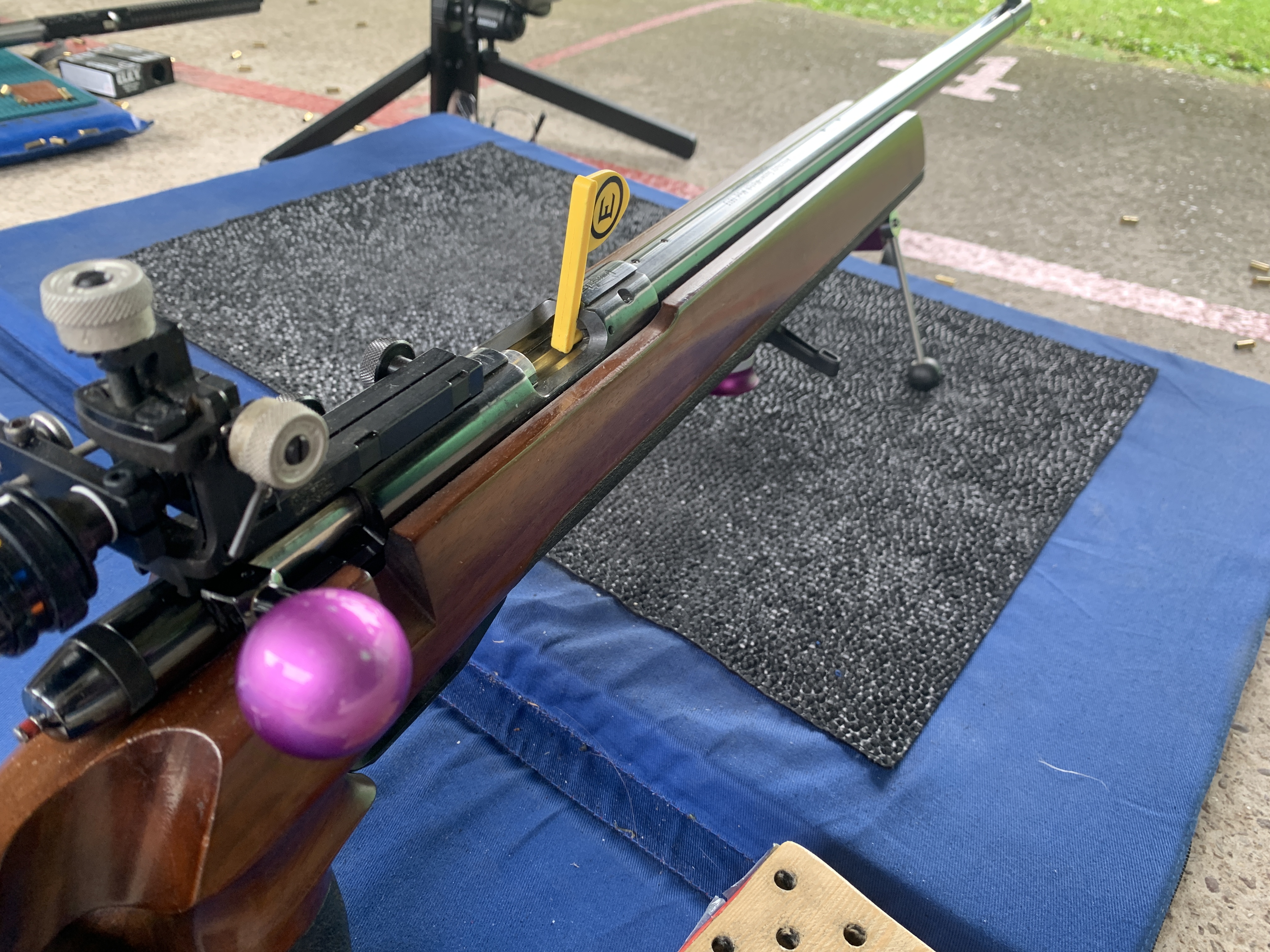
Yellow empty-chamber flag inserted in the open breech of a wooden-stock Anschütz target rifle resting on a blue shooting mat.

A yellow breech flag fitted to the open action of an Anschütz 1913 target rifle. An ECI photograph is not proof that all ammunition is removed. Photograph unchanged.

Photograph: Hemmers · CC BY-SA 4.0 · Original photograph and source
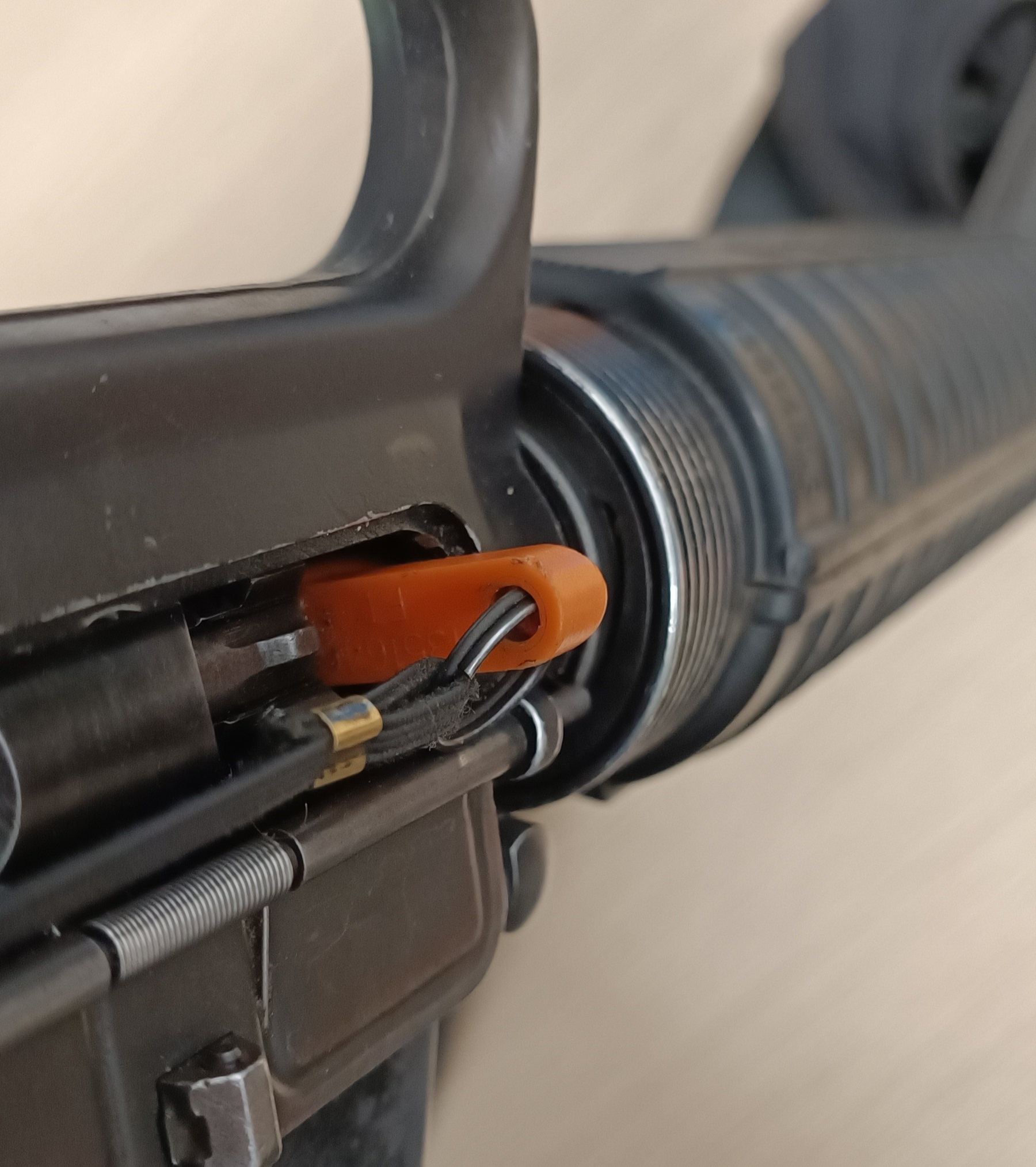
Orange plastic empty-chamber indicator with a retaining loop visible through the open ejection port of an M16 rifle.

Close-up of an orange empty-chamber indicator fitted in an M16 rifle. This close-up does not establish magazine removal or the complete firearm's unloaded condition. Photograph unchanged.

Photograph: אברהם שוורץ (Avraham Schwartz) · CC BY-SA 4.0 · Original photograph and source

Real ECI photographs — reference for website publication

Photographs of actual empty chamber indicators and examples fitted to firearms are available at: https://commons.wikimedia.org/wiki/Category:Empty_chamber_indicator

Australian product photograph example: https://www.bosscomponents.com.au/products/pack-of-four-chamber-safety-flags

These original photo references are not a licence grant. Check each photograph’s individual reuse terms; the product page is retained as a reference, not an image hotlink.

Historical Word-file image-insertion note

The following notes are preserved verbatim from the supplied Word document. They describe that document’s research and editorial context, not an exhaustive audit completed by this website. The historical image-insertion note concerns the Word file, not whether photographs appear on this page.

Image insertion note: Actual photographs have not been embedded in this Word file because the image files could not be retrieved. Use an appropriately licensed or permission-cleared photograph from the linked sources before publishing; do not substitute an illustration as a real product photo.

Sources: https://vapa.org.au/wp-content/uploads/2024/05/VAPA-Member-Handbook-2023-24.pdf ; https://beaudesertrifleclub.com.au/empty-chamber-indicator/

Licensing

Firearms licensing and possession are regulated by each state and territory. Generally, you need the relevant licence or other lawful authority — and often a separate permit to acquire — before possessing or acquiring a firearm. A genuine reason, compliant safe storage, and waiting periods are common requirements; inspection procedures and exceptions vary by jurisdiction. Commonwealth rules also apply to imports and exports

01

How to Obtain a Firearms Licence

Adult Firearms Licence

Requirements change by jurisdiction. Use the official authority for the state or territory where you live, and confirm the current rules before applying or travelling. Authority links checked 6 November 2026.

Firearms licensing is administered independently by each Australian state and territory. Although requirements vary, the general process involves the following steps.

  1. Step 1 – Establish Your Genuine Reason

    Applicants must demonstrate a legally recognised genuine reason for obtaining a firearms licence.

    Depending on the jurisdiction, recognised reasons may include:

    • Sport and target shooting
    • Recreational hunting
    • Primary production
    • Occupational requirements
    • Other purposes recognised under the applicable legislation
  2. Step 2 – Find a Shooting Club or Training Provider

    Joining an approved shooting club is an excellent starting point for anyone interested in organised shooting sports.

    Clubs can provide information about membership, introductory activities, safety requirements, training and competitive shooting disciplines.

  3. Step 3 – Complete Firearms Safety Training

    Applicants may need to complete an approved firearms safety course.

    Training requirements depend on the state or territory, licence category and genuine reason.

  4. Step 4 – Submit Your Licence Application

    Applications are made through the relevant police or government licensing authority.

    Applicants may need to provide:

    • Proof of identity
    • Evidence supporting their genuine reason
    • Firearms safety training documentation
    • Club membership or other supporting evidence
    • Applicable application fees
    • Additional documentation required by the licensing authority

    Background checks, waiting periods and other assessments may apply.

  5. Step 5 – Receive Your Licence and Get Involved

    Once appropriately licensed or otherwise legally authorised, participants can explore club activities, training opportunities and recognised shooting disciplines.

    A firearms licence does not automatically authorise the acquisition of a firearm. Separate permits or approvals may be required.

NSWNew South WalesNSW Police Force Firearms RegistryLicences, Permit to Acquire applications, genuine-reason guidance and safe-storage information.VICVictoriaVictoria Police Licensing and Regulation DivisionFirearms licence applications, renewals, permits, storage and licence management.QLDQueenslandQueensland Police Service Weapons LicensingWeapons licences, permits to acquire, genuine reason, training and safe-storage guidance.WAWestern AustraliaWestern Australia Police ForceFirearms licensing, the WA Firearms Portal, renewals and permit pathways.SASouth AustraliaSouth Australia Police Firearms BranchLicence applications, genuine reason, safety training, permits to acquire and registration.TASTasmaniaTasmania Police Firearms ServicesLicence categories, genuine reason, applications, permits to acquire and storage guidance.ACTAustralian Capital TerritoryACT Policing Firearms RegistryLicence eligibility, genuine reason, permits, secure storage and training requirements.NTNorthern TerritoryNorthern Territory Police Firearms Policy and Recording UnitLicence and permit applications, genuine need, training, storage and current process guidance.

Maps adapted from Rycherr, Wikimedia Commons · CC BY-SA 4.0.

02

Junior Shooters

Junior Firearms Permit or Licence

Target shooting offers young people opportunities to learn concentration, discipline, responsibility, teamwork and safe sporting skills. You do not need to come from a shooting family to ask a club about joining. A welcoming, approved club can explain its junior program, introductory sessions and suitable supervised activities.

National information guide · 16 November 2026 · Confirm current requirements with the relevant authority.

Getting started — six simple steps

  1. Step 1 – Find an Approved Shooting Club

    Contact an approved shooting club and ask whether it welcomes junior members and offers supervised introductory sessions. Ask which disciplines and firearm categories are available for your age group.

  2. Step 2 – Check Your State or Territory Requirements

    Confirm the minimum age, whether a junior permit or licence is required, and whether a supervised-use exemption is available. The rules vary across Australia; refer to the state and territory guidance below.

  3. Step 3 – Confirm Consent and Supervision

    Check whether a parent or guardian must provide written consent and who may legally supervise a junior. An appropriately licensed club instructor or other adult may be eligible to supervise, but this does not automatically replace parental or guardian consent.

  4. Step 4 – Complete Safety Training and Prepare Your Application

    Complete any required firearms safety training and club membership requirements. Prepare the identification, consent, supporting documents and other evidence required by the relevant licensing authority.

  5. Step 5 – Apply for the Correct Junior Permit or Licence

    Where required, apply through the appropriate police firearms registry. Some jurisdictions instead provide lawful supervised-use arrangements. An application alone does not authorise possession or use.

  6. Step 6 – Receive Approval and Participate Safely

    Wait for the necessary approval or confirm the applicable exemption before participating. Follow the range officer’s instructions, supervision conditions and all range safety rules.

Junior Firearms Permits, Licences and Requirements by State and Territory

Junior firearms licensing and supervised shooting requirements vary across Australia. Select your state or territory below to access official information about junior permits, licences, eligibility and supervised participation.

NSWNew South WalesMinor’s Firearms PermitAges 12–17 · supervised useVICVictoriaJunior Firearm LicenceAges 12–17 · endorsed applicationQLDQueenslandMinor’s LicenceAges 11–17 · parental consent letterWAWestern AustraliaJunior Supervised Firearm UseAges 12–17 · immediate supervisionSASouth AustraliaJunior Firearms RequirementsAges 10–17 supervised · limited licences from 12TASTasmaniaMinor’s PermitAges 12–17 · written parental consentACTAustralian Capital TerritoryMinor’s Firearms LicenceAges 12–17 · parent must hold a target licenceNTNorthern TerritoryFirearms Club Junior LicenceFrom age 10 · club and parental consent

Maps adapted from Rycherr, Wikimedia Commons · CC BY-SA 4.0.

Do your parents need firearms licences?

Not necessarily. A junior may be supervised by an appropriately licensed adult who is not their parent, such as an authorised club instructor or another eligible supervisor. But this is NOT the same as saying parental permission is never required. Many jurisdictions expressly require a parent or guardian to consent to the application or activity. A nominated supervisor or exemption form does not automatically replace parental consent. Always check both requirements independently.

A note for Tasmania: permits and exemptions

Tasmania’s standard minor’s permit requires permission from a parent or guardian under section 69 of the Firearms Act 1996. Section 70 separately deals with who may supervise. A licensed non-parent supervisor can therefore be eligible without replacing the parent/guardian consent requirement. If a club refers to a particular exemption or nominated-supervisor form, confirm its exact legal authority and scope with Tasmania Police Firearms Services before relying on it.

Questions to ask your first club

  • Do you accept junior members and offer a supervised introductory visit?
  • What minimum age applies to my chosen discipline?
  • Can an approved club instructor supervise me if my parents do not shoot?
  • What parental or guardian consent is required?
  • Which licence, permit or exemption applies, and who submits the paperwork?
  • What protective equipment should I bring, and is loan equipment available?

Safety comes first

Always follow the range officer’s instructions. Treat every firearm as loaded; keep it pointed in a safe direction; keep your finger away from the trigger until ready to fire; and identify the target and what lies beyond it. Wear suitable eye and hearing protection and never handle a firearm without the required authorisation and supervision.

Important legal notice

This guide is general educational information, not legal advice or approval to possess or use firearms. Laws, administrative practices, age thresholds, categories and forms can change. Requirements may differ between an introductory session, a junior licence, competition, field use and handgun shooting. Before participating or applying, check the current legislation and obtain confirmation from your state or territory firearms registry. Where police information sheets conflict, seek written clarification; Northern Territory junior ages and permit stages particularly warrant confirmation.

RANGE FINDER AUSTRALIA | Connecting shooters with ranges, training and information.

Reference check: 16 November 2026. Legislation and administrative requirements may change. Consult the linked regulator and current legislation before applying.

03

Understanding Firearms Licence Categories

Categories A to H, how mechanism shapes classification, and each state and territory's requirements.

Firearms in Australia are classified into different categories based on their type, operating mechanism and other characteristics. Understanding these categories is an important part of knowing which firearms may be authorised under a particular licence.

From rifles and shotguns to handguns and self-loading firearms, each category has specific licensing requirements and restrictions that may vary between Australian states and territories.

Explore the different firearms categories, what they mean, the types of firearms they cover and how category authorisations may be represented on a firearms licence.

Rifles • Shotguns • Handguns • Self-loading firearms • Special categories | Research edition: 16 November 2026

Educational reference only. Category definitions and licence endorsements differ by jurisdiction, genuine reason, firearm configuration and current legislation. Always confirm with the relevant firearms registry before applying, acquiring or using a firearm.

01
Understanding Firearm Categories
How to read the categories

A firearm category describes the firearm type. A licence type or genuine reason describes why a person is authorised to possess or use it. A licence may include multiple categories, conditions and endorsements. Category H generally concerns handguns; self-loading longarms often fall within C or D depending on mechanism and magazine capacity. Category labels are not interchangeable across all jurisdictions.

CodeTypical meaning (not universal)Illustrative firearm type
ACommon sporting longarmsNon-self-loading .22 rimfire rifle; break-action shotgun; air rifle
BOther manually operated longarmsNon-self-loading centrefire rifle; muzzle-loader; certain lever-action shotguns
CRestricted self-loading rimfire / shotgunsSelf-loading rimfire rifle up to 10 rounds; pump/self-loading shotgun up to 5 rounds
DMore restricted self-loading longarmsSelf-loading centrefire rifle; specified higher-capacity self-loading longarms
HHandgunsAir pistol, revolver, semi-automatic pistol
ESpecial category in Victoria and WA (different definitions)Special/restricted firearms; WA also includes prescribed paintball guns
P / ZSA-specific endorsementsPrescribed firearm / ammunition only
M / RQueensland weapons categories, not ordinary rifle licence categoriesCategory M weapons / Category R restricted weapons
Mechanism matters
TermPlain-English explanation
Bolt-action / lever-action / break-actionManually operated actions; classification still depends on firearm and state law.
Pump-actionManually cycled by a sliding fore-end; pump-action shotguns often classified C or D.
Self-loading / semi-automaticUses firing energy to chamber the next round; longarm category depends on design, calibre and capacity.
Fully automaticContinues firing while trigger remains actuated; generally prohibited or subject to exceptional authorisation.
Rimfire / centrefireDifferent cartridge ignition types; important to category classification.
Magazine capacityA legal classification threshold in many categories; other restrictions may also apply.
02
Category A
Typical meaning (not universal)
Common sporting longarms
Illustrative firearm type
Non-self-loading .22 rimfire rifle; break-action shotgun; air rifle
Jurisdiction notes
  • NSW A: air rifles, non-self-loading rimfire, ordinary shotguns.
  • VIC A/B broadly follow standard sporting longarm classes.
  • QLD A/B ordinary longarms.
  • SA A/B common sporting longarms
  • WA A includes certain non-self-loading air rifles, rimfire rifles and bolt/break shotguns.
  • TAS A non-self-loading rimfire, air rifle and ordinary shotgun.
  • ACT A includes air rifles, non-self-loading rimfire and ordinary shotguns
  • NT A ordinary longarms.
03
Category B
Typical meaning (not universal)
Other manually operated longarms
Illustrative firearm type
Non-self-loading centrefire rifle; muzzle-loader; certain lever-action shotguns
Jurisdiction notes
  • NSW B: manually operated centrefire and muzzle-loaders, lever shotgun ≤5.
  • VIC A/B broadly follow standard sporting longarm classes.
  • QLD A/B ordinary longarms.
  • SA A/B common sporting longarms
  • WA B includes manually operated centrefire, muzzle-loaders and certain lever shotguns.
  • TAS B non-self-loading centrefire and muzzle-loader.
  • ACT B includes muzzle-loaders and non-self-loading centrefire
  • NT B non-self-loading centrefire, muzzle-loaders and lever shotgun ≤5.
04
Category C
Typical meaning (not universal)
Restricted self-loading rimfire / shotguns
Illustrative firearm type
Self-loading rimfire rifle up to 10 rounds; pump/self-loading shotgun up to 5 rounds
Jurisdiction notes
  • NSW C: self-loading rimfire ≤10; self-loading/pump shotgun ≤5.
  • VIC C covers specified limited-capacity self-loading rimfire/shotguns and tranquilliser guns.
  • QLD C limited-capacity semi-automatic rimfire and pump/semi-auto shotguns.
  • SA C and D restricted self-loading categories
  • WA C/D cover specified self-loading firearms.
  • TAS C self-loading rimfire ≤10; self-loading/pump shotgun ≤5.
  • ACT C/D are restricted self-loading categories
  • NT C self-loading rimfire ≤10, pump/self-loading shotgun ≤5, tranquilliser and paintball types.
05
Category D
Typical meaning (not universal)
More restricted self-loading longarms
Illustrative firearm type
Self-loading centrefire rifle; specified higher-capacity self-loading longarms
Jurisdiction notes
  • NSW D: self-loading centrefire and higher-capacity specified firearms; lever shotgun >5.
  • VIC D covers self-loading centrefire and higher-capacity types.
  • QLD D self-loading centrefire and higher-capacity specified longarms.
  • SA C and D restricted self-loading categories
  • WA C/D cover specified self-loading firearms.
  • TAS D self-loading centrefire and specified higher-capacity types.
  • ACT C/D are restricted self-loading categories
  • NT D includes self-loading centrefire and higher-capacity types plus specific declared firearms.
06
Category E and Other Special Categories
Typical meaning (not universal)
Special category in Victoria and WA (different definitions)
Illustrative firearm type
Special/restricted firearms; WA also includes prescribed paintball guns
Jurisdiction notes
  • VIC E is a special restricted longarm category; handguns have separate general/E licensing.
  • WA E includes cannon, kiln gun, prescribed paintball gun, tranquilliser gun and underwater explosive device.
Other special categories
CodeTypical meaning (not universal)Illustrative firearm type
P / ZSA-specific endorsementsPrescribed firearm / ammunition only
M / RQueensland weapons categories, not ordinary rifle licence categoriesCategory M weapons / Category R restricted weapons
07
Category H — Handguns
Typical meaning (not universal)
Handguns
Illustrative firearm type
Air pistol, revolver, semi-automatic pistol
Jurisdiction notes
  • NSW H: pistols.
  • QLD H handguns.
  • SA H handguns
  • WA H handguns.
  • TAS H pistols and air pistols.
  • ACT H is handguns.
  • NT H pistols and air pistols.
  • VIC handguns have separate general/E licensing.
08
State and Territory Requirements

Choose a state or territory. Only one opens at a time.

NSW
New South Wales
A B C D H
Categories / licence structure
A, B, C, D, H; separate dealer and collector licences.
Classification summary
A: air rifles, non-self-loading rimfire, ordinary shotguns. B: manually operated centrefire and muzzle-loaders, lever shotgun ≤5. C: self-loading rimfire ≤10; self-loading/pump shotgun ≤5. D: self-loading centrefire and higher-capacity specified firearms; lever shotgun >5. H: pistols.
Official category guidance / legislation (NSW) Further official licensing reference (NSW)
VIC
Victoria
A B C D E
Categories / licence structure
Longarms A, B, C, D, E; general-category and Category E handgun licences; junior, collector, heirloom and other types.
Classification summary
A/B broadly follow standard sporting longarm classes. C covers specified limited-capacity self-loading rimfire/shotguns and tranquilliser guns. D covers self-loading centrefire and higher-capacity types. E is a special restricted longarm category; handguns have separate general/E licensing.
Official category guidance / legislation (VIC) Further official licensing reference (VIC)
QLD
Queensland
A B C D H M R
Categories / licence structure
Weapons categories A, B, C, D, H, M and R; licence types include firearms and concealable firearms licences.
Classification summary
A/B ordinary longarms. C limited-capacity semi-automatic rimfire and pump/semi-auto shotguns. D self-loading centrefire and higher-capacity specified longarms. H handguns. M includes certain other weapons; R includes highly restricted weapons.
Official category guidance / legislation (QLD) Further official licensing reference (QLD)
SA
South Australia
A B C D H P Z
Categories / licence structure
Firearm classes A, B, C, D, H, P; application form also lists Z (ammunition only). Separately, numbered licence categories 1–12 describe purpose.
Classification summary
A/B common sporting longarms; C and D restricted self-loading categories; H handguns; P prescribed firearms; Z ammunition-only endorsement. Licence Category 1 = shooting club; 2 = target shooting; 3 = hunting, etc. Do not confuse the numbers with firearm letters.
Official category guidance / legislation (SA) Further official licensing reference (SA)
WA
Western Australia
A B C D E H
Categories / licence structure
Firearm categories A, B, C, D, E, H under the Firearms Act 2024 / Regulations 2024. Licence types include Individual, Business, Primary Producer, Collector, Club, Range, Trade and Government Entity.
Classification summary
A includes certain non-self-loading air rifles, rimfire rifles and bolt/break shotguns. B includes manually operated centrefire, muzzle-loaders and certain lever shotguns. C/D cover specified self-loading firearms. E includes cannon, kiln gun, prescribed paintball gun, tranquilliser gun and underwater explosive device. H handguns.
Official category guidance / legislation (WA) Further official licensing reference (WA)
TAS
Tasmania
A B C D H
Categories / licence structure
A, B, C, D and H; restricted categories depend on genuine need and purpose.
Classification summary
A non-self-loading rimfire, air rifle and ordinary shotgun. B non-self-loading centrefire and muzzle-loader. C self-loading rimfire ≤10; self-loading/pump shotgun ≤5. D self-loading centrefire and specified higher-capacity types. H pistols and air pistols.
Official category guidance / legislation (TAS) Further official licensing reference (TAS)
ACT
Australian Capital Territory
A B C D H
Categories / licence structure
Five main firearms licence categories: A, B, C, D and H.
Classification summary
A includes air rifles, non-self-loading rimfire and ordinary shotguns; B includes muzzle-loaders and non-self-loading centrefire; C/D are restricted self-loading categories; H is handguns. Genuine reason and other conditions control eligibility.
Official category guidance / legislation (ACT) Further official licensing reference (ACT)
NT
Northern Territory
A B C D H
Categories / licence structure
A, B, C, D and H; NT Police also lists specific Commissioner declarations.
Classification summary
A ordinary longarms. B non-self-loading centrefire, muzzle-loaders and lever shotgun ≤5. C self-loading rimfire ≤10, pump/self-loading shotgun ≤5, tranquilliser and paintball types. D includes self-loading centrefire and higher-capacity types plus specific declared firearms. H pistols and air pistols.
Official category guidance / legislation (NT) Further official licensing reference (NT)
09
How Licence Categories May Appear on a Licence
Illustrative licence-category displays — NOT licence replicas

The following examples show how authorisation codes might be presented in educational materials. They are not actual licence-card formats, not evidence of authority, and deliberately omit identity features, licence numbers, signatures, seals, QR codes and expiry dates. The issuing authority may print different wording or place conditions in a separate record.

Example A — sporting longarms
Educational example only
JurisdictionNSW (illustrative)
Authorised firearm categoriesA, B
Genuine reasonSport / Target Shooting
MeaningSelected ordinary rimfire/shotguns and eligible manually operated centrefire rifles, subject to licence conditions
Example B — handgun
Educational example only
JurisdictionTAS (illustrative)
Authorised firearm categoryH
Genuine reasonSport / Target Shooting
MeaningSpecified eligible handguns subject to club, licence and acquisition restrictions
Example C — SA purpose versus firearm class
Educational example only
JurisdictionSA (illustrative)
Licence purpose category1 — Shooting Club
Firearm category endorsementA, B
MeaningPurpose number and firearm class letters describe different things
Example D — WA firearm-specific authorisation
Educational example only
JurisdictionWA (illustrative)
Licence typeIndividual — Competition
Authorised firearm categoryB
MeaningAuthorisation also relates to specified firearm(s), purpose and conditions
10
Important Licensing Information and References
Important exceptions and terminology
  • Lever-action shotgun categories vary; a five-round threshold is common in several states, but classification must be checked locally.
  • Some paintball, airgun, tranquiliser and combination firearms are categorised differently between jurisdictions.
  • Category H does not mean unrestricted access to all handguns. Barrel length, calibre, magazine capacity, genuine reason and club conditions may apply.
  • A firearms category is not itself a permit to acquire, own, carry or use a firearm. Licensing and registration requirements are additional.
  • A self-loading centrefire rifle is not classified like a manually operated centrefire rifle.
  • Collector, dealer, security, primary production, junior and occupational authorities may use distinct licence types and endorsements.
  • Actual printed licence formats differ by jurisdiction and may change; the guide does not reproduce government credentials.
Editorial verification checklist before website publication
  • Recheck the current consolidated Act and regulations for each jurisdiction (especially WA reforms and special declarations).
  • Confirm category restrictions against the actual firearm configuration and the applicant’s genuine reason.
  • Have a qualified local firearms licensing specialist review the state-specific summaries.
  • Use official government pages as the authoritative source; do not present the examples as real licence images.
  • Review the guide periodically and date any changes.

This guide is general educational information, not legal advice. It is reproduced from the supplied research edition dated 16 November 2026; every official link below is carried across unchanged and should be rechecked before publication.

Official references
  • NSWCategory guidance and legislation Further licensing reference
  • VICCategory guidance and legislation Further licensing reference
  • QLDCategory guidance and legislation Further licensing reference
  • SACategory guidance and legislation Further licensing reference
  • WACategory guidance and legislation Further licensing reference
  • TASCategory guidance and legislation Further licensing reference
  • ACTCategory guidance and legislation Further licensing reference
  • NTCategory guidance and legislation Further licensing reference

Rangefinder Australia – Legal and Disclaimers

Legal Information

General Disclosure Statement

Within this Legal and Disclaimers section, Rangefinder Australia sets out the basis on which information is provided through our platform, including the responsibilities of shooting clubs, range operators and firearms licensing authorities.

All information published by Rangefinder Australia is provided for general information and guidance purposes only.

While we endeavour to ensure information is accurate, relevant and up to date, Rangefinder Australia makes no guarantees regarding the accuracy, completeness or currency of information provided.

Club Membership and Range Access

Rangefinder Australia does not control, influence or accept responsibility for the approval, refusal, suspension or cancellation of shooting club memberships or access to shooting ranges.

All decisions relating to membership applications, eligibility, range access and participation remain the sole responsibility of the respective shooting clubs, their committees, range operators and authorised representatives.

These decisions are governed by each organisation's individual rules, policies, membership requirements and applicable legislation.

Firearms Licensing

Firearms licensing throughout Australia is administered independently by the relevant state and territory government authorities in accordance with their respective legislation and regulations.

Rangefinder Australia does not issue firearms licences, assess applications, determine eligibility or influence licensing decisions.

All licensing approvals, refusals, suspensions, cancellations and associated requirements remain the responsibility of the relevant licensing authority.

Information relating to firearms licensing is provided for general guidance only. Users should refer directly to the appropriate state or territory government authority for current legislative requirements, application procedures and official advice.

Disclaimers

Limitation of Liability

To the extent permitted by Australian law, Rangefinder Australia accepts no responsibility or liability for decisions made by shooting clubs, range operators, committees, government licensing authorities or other relevant organisations.

This includes, but is not limited to, the approval, refusal, suspension or cancellation of club memberships, firearms licences or shooting range access.

Rangefinder Australia is an independent information and referral platform and does not guarantee membership acceptance, licensing approval or access to any shooting facility.

User Responsibility

Users are responsible for confirming that information obtained through Rangefinder Australia is current, accurate and applicable to their individual circumstances.

Users should contact the relevant shooting club, range operator or government licensing authority directly before making applications, payments or arrangements based on information provided through the platform.

By accessing and using Rangefinder Australia, users acknowledge the general informational nature of the platform and the independent responsibilities of the relevant clubs, organisations and government authorities.

Nothing in this statement excludes, restricts or modifies any rights or remedies that cannot lawfully be excluded under Australian law.

Developed by shooters, for the shooting community.

Useful Links

Verified ballistics applications, official downloads and manuals, plus Australian firearms licensing, acquisition, storage and legislation resources. Listing does not imply endorsement; always confirm current details with the official source.

Ballistics Calculators

Verified mobile ballistics applications, official store downloads and manuals. Calculations are estimates and do not replace safe firearm handling or professional judgement.

Open category page

Hornady Ballistics 4DOF

Hornady's mobile application combines its 4DOF and conventional ballistic-coefficient calculators with an ammunition library. The official iPhone and Android listings are linked below. Hornady also links a related online 4DOF calculator; its interactive operation was not tested.

  • 4DOF and ballistic-coefficient calculators
  • Saved equipment profiles and bullet/ammunition libraries
  • Offline calculation and compatible Bluetooth weather-meter integration

Supported platforms

  • iOS — iPhone
  • Android
Open official resource (opens in a new tab)Hornady Ballistics — Australian App Store (opens in a new tab)Hornady — official Google Play listing (opens in a new tab)Hornady 4DOF — related online calculator, not a mobile-app download (opens in a new tab)Official 4DOF Instructions — HTML calculator guide (opens in a new tab)Official 4DOF Technical Document — technical/user guide (opens in a new tab)

Last verified 2026-11-13

Applied Ballistics Mobile — current successor AB Quantum

Applied Ballistics Mobile is the legacy app name. The current developer-linked store listings are AB Quantum / Applied Ballistics Quantum, not a separately verified download of the old Mobile edition. The Quantum manual and the clearly labelled archived Mobile guide are linked below.

  • Ballistic data and rifle/ammunition profile management
  • Compatible Bluetooth device integration and encrypted profile backup/sync
  • Customisable cards, reticle libraries and educational content

Supported platforms

  • iOS
  • iPadOS
  • Android
Open official resource (opens in a new tab)AB Quantum — current successor, Apple App Store Australia (opens in a new tab)Applied Ballistics Quantum — current successor, Google Play (opens in a new tab)Applied Ballistics Mobile — archived July 2018 user guide (opens in a new tab)AB Quantum User Manual — Application 3.7, Rev 3, April 2026 (opens in a new tab)

Last verified 2026-11-13

Shooter: Ballistic Calculator

Kennedy Development Group's mobile external-ballistics application supports saved firearm and ammunition profiles, trajectory tables and target cards. Calculations run locally; online weather and cloud profile synchronisation need connectivity. Its web portal manages profiles and is not a verified browser calculator.

  • Firearm/ammunition profiles and bullet-data library
  • Trajectory tables, target cards and metric units
  • Weather/Bluetooth weather-meter integration and cloud profile backup/sync

Supported platforms

  • iOS — iPhone
  • iPadOS — iPad
  • Android
Open official resource (opens in a new tab)Shooter: Ballistic Calculator — Australian App Store (opens in a new tab)Shooter: Ballistic Calculator — Google Play (opens in a new tab)Official Shooter Operation Manual — updated 25 April 2026 (opens in a new tab)

Last verified 2026-11-13

Independent resource directory. Listing does not imply endorsement. Application availability and information may change; follow the official source for current details.

Contact Us

Helping Australia’s shooting community
find their place, together.

EXPLORE
Find a rangeAdd your clubEventsOrganisationsUseful LinksSubmit an eventSubmit an advertisementGetting startedTravelling with firearmsOur purposeLegal InformationDisclaimers
GOOD TO KNOW

Always confirm club details, visitor requirements, event dates and current regulations with the organiser and relevant authority.

ADMIN SIGN IN
© 2026 RANGE FINDER AUSTRALIAINDEPENDENT DIRECTORY · NOT A LICENSING AUTHORITY